Synopsis
Prince Adam returns to battle the forces of evil, defend Eternia and become He-Man once more.
At least that was the plan.
What follows is a two-hour assault on nostalgia featuring questionable dialogue, relentless one-liners and a villain who somehow manages to make world domination look less appealing than a Monday morning Teams meeting.
What I Expected
As a child of the 80s, I went into this film hoping for a bit of nostalgia.
Not a frame-by-frame recreation of the cartoon.
Not an Oscar-winning masterpiece.
Just a fun trip back to Eternia.
I also deliberately avoided looking too closely at the cast beforehand.
For me, this wasn’t about actors.
It was about revisiting a small part of my childhood.
Unfortunately, what followed was less a return to Eternia and more a large-scale transformation programme that appeared to have lost sight of its original requirements somewhere during delivery.
What I Got
The acting was, at best, variable.
The dialogue often felt like it had been generated by feeding every Marvel script into an AI model and then asking it to remove all of the good bits.
The humour rarely landed.
The dramatic moments rarely felt dramatic.
And the emotional moments had all the impact of a strongly worded email.
From a project perspective, the film also appeared to suffer from a lack of clear requirements.
At no point was I entirely sure who the target audience was supposed to be.
Long-time fans expected a return to Eternia.
New audiences needed an introduction to the world.
The film somehow managed to underserve both groups simultaneously.
This is generally considered an anti-pattern.
Skeletor deserves special mention.
Not because he was particularly threatening.
Not because he was particularly memorable.
But because he managed to transform one of the most iconic villains in fantasy into a walking collection of cringe-worthy one-liners.
At one point I found myself wondering how this had happened.
Then I discovered afterwards that Skeletor was played by Jared Leto.
Suddenly a number of creative decisions began to make sense.
Not good decisions.
But decisions.
Even Idris Elba couldn’t save this one.
Which is saying something because he was legendary as Heimdall in the Thor films.
Here he looked like a senior engineer who had joined a project halfway through, realised the architecture was fundamentally flawed and was simply trying to survive until the end of the contract.
Governance Review
Several questions remained unanswered throughout the film:
- Who approved this script?
- Were user requirements gathered?
- Was there stakeholder engagement?
- Did anyone perform acceptance testing?
- Was there a lessons learned review from previous adaptations?
The final product suggests either significant scope creep or a complete breakdown in quality assurance.
Possibly both.
A post-implementation review is strongly recommended.
Change Management
Modernising a beloved franchise is always difficult.
Change itself is not the problem.
Poorly managed change is.
Successful transformations bring existing stakeholders along on the journey.
This felt more like somebody archived the existing requirements document, ignored stakeholder feedback and proceeded directly to production.
The result is a film that carries the He-Man branding whilst frequently appearing uncertain about what made He-Man popular in the first place.
User Acceptance Testing
One cannot help but wonder whether this film underwent any meaningful user acceptance testing.
If it did, the findings were apparently ignored.
The project team appears to have reached the point where every stakeholder concern was answered with:
“We’ll take that away.”
And then never discussed again.
Risk Management
Several risks appear to have been identified during production.
Unfortunately, they all materialised.
RAID Log
| ID | Type | Description | Status |
|---|---|---|---|
| R001 | Risk | Alienating existing fans | Materialised |
| R002 | Risk | Weak villain characterisation | Materialised |
| R003 | Risk | Excessive reliance on one-liners | Materialised |
| R004 | Risk | Lack of emotional engagement | Materialised |
| R005 | Risk | Franchise identity loss | Materialised |
| I001 | Issue | Audience disappointment | Active |
| I002 | Issue | Narrative coherence concerns | Active |
| A001 | Assumption | Nostalgia alone would carry the film | Incorrect |
Unlike The Empire Strikes Back, where Luke Skywalker ignored the RAID log, this project appears to have ignored the RAID log before filming even began.
This demonstrates admirable consistency.
Review
The highlight of the film?
A brief Dolph Lundgren cameo.
Not because of nostalgia.
Not because of the acting.
Simply because it was a respectful nod to the 1987 film — the only moment in two hours that felt like it understood what this property actually means to people.
Battle Cat eventually appeared.
The end credits also appeared.
Both were welcome developments.
The more I thought about it afterwards, the more it felt like a project that had lost sight of its original objectives.
The branding was present.
The budget was present.
The special effects were present.
The thing that appeared to be missing was a clear understanding of why people liked He-Man in the first place.
There are films that take risks and successfully reinvent a franchise.
This was not one of them.
I’d rather spend two hours troubleshooting printer drivers over a VPN connection than sit through this again.
Movie Scorecard
| Category | Rating | Comments |
|---|---|---|
| Story | ☆☆☆☆☆ | Largely forgettable |
| Acting | ☆☆☆☆☆ | Some strong actors unable to save weak material |
| Dialogue | ☆☆☆☆☆ | Frequently painful |
| Villain | ☆☆☆☆☆ | Skeletor deserved better |
| Nostalgia Factor | ★☆☆☆☆ | Very little of what made the original special |
| Battle Cat | ★★☆☆☆ | Eventually appeared |
| Dolph Lundgren Cameo | ★★★★★ | Best decision made all film |
Overall Movie Assessment
🔴 Critical
A film that appears determined to misunderstand its own source material.
Architecture & Programme Assessment Scorecard
| Area | Rating | Comments |
|---|---|---|
| Governance | ☆☆☆☆☆ | Approval process remains unclear |
| Requirements Gathering | ☆☆☆☆☆ | Stakeholder expectations not fully captured |
| Change Management | ☆☆☆☆☆ | Significant deviation from original design |
| Risk Management | ☆☆☆☆☆ | Every major risk materialised |
| Quality Assurance | ☆☆☆☆☆ | Additional testing recommended |
| Stakeholder Engagement | ☆☆☆☆☆ | Fan feedback appears absent |
| Battle Cat Deployment | ★★☆☆☆ | Eventually reached production |
| Dolph Lundgren Integration | ★★★★★ | Exemplary implementation |
Overall Maturity Assessment
🔴 Critical
The programme successfully delivered a film.
Whether it successfully delivered a He-Man film remains open for discussion.
Movie Hub Metrics
| Metric | Result |
|---|---|
| Risks Materialised | 5 |
| Stakeholders Consulted | Unclear |
| Requirements Met | Questionable |
| User Acceptance Testing | Not Evident |
| Battle Cats Deployed | 1 |
| Dolph Lundgren Appearances | 1 |
| Times I Would Watch Again | 0 |
| Printer Drivers Preferred | Yes |
Final Verdict
By the Power of Grayskull…
I would not watch this again.
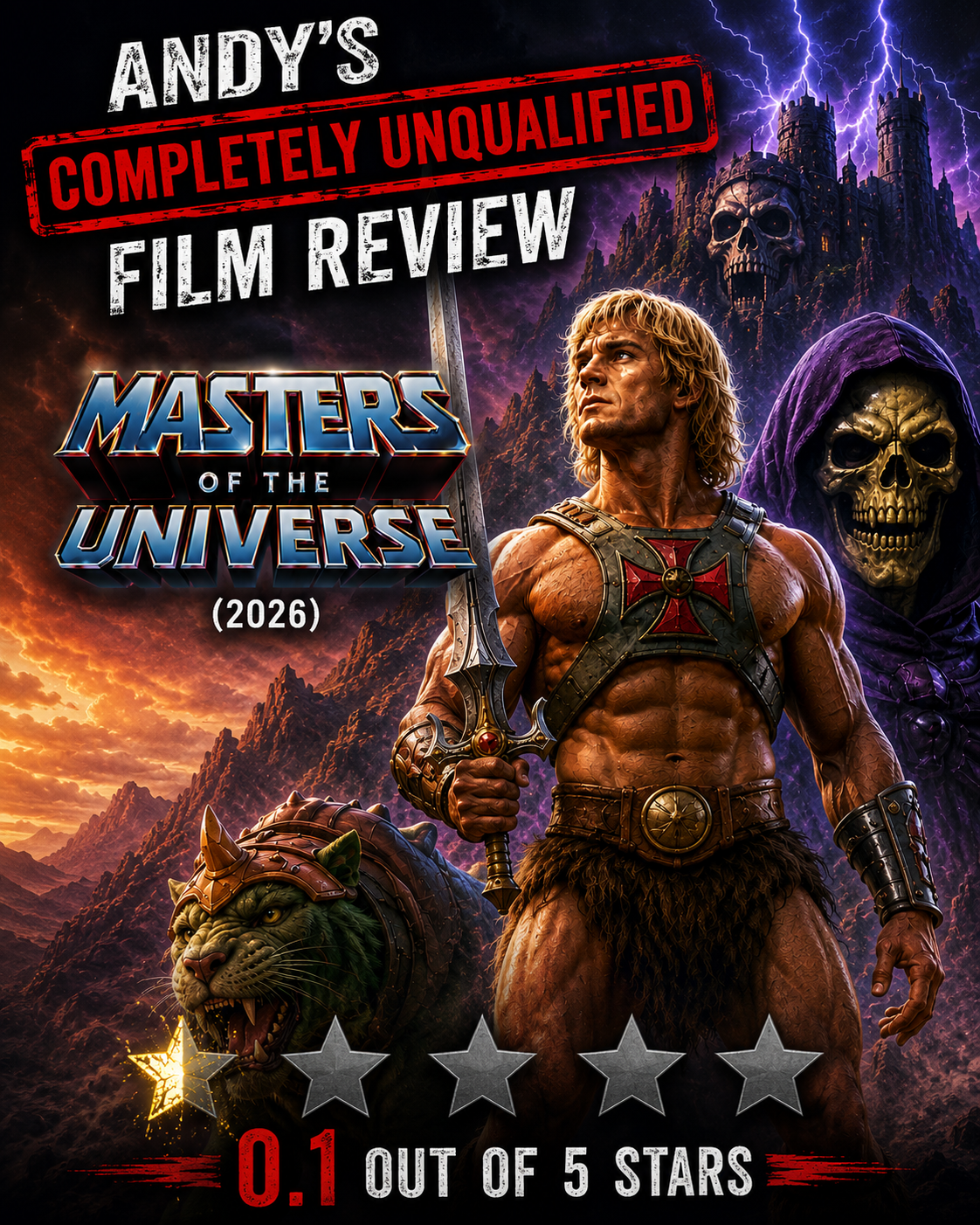
The 0.1 out of 5 is awarded for Battle Cat — who did eventually appear near the end, though even that was a bit meh — and Dolph Lundgren’s cameo.
Without them, this review would have required negative numbers.
A rare example of a project where the post-implementation review may be more enjoyable than the final deliverable.
Comments
Comments are not yet configured. Copy
.env.exampleto.env, fill in your Giscus values, and they will appear here.