Synopsis
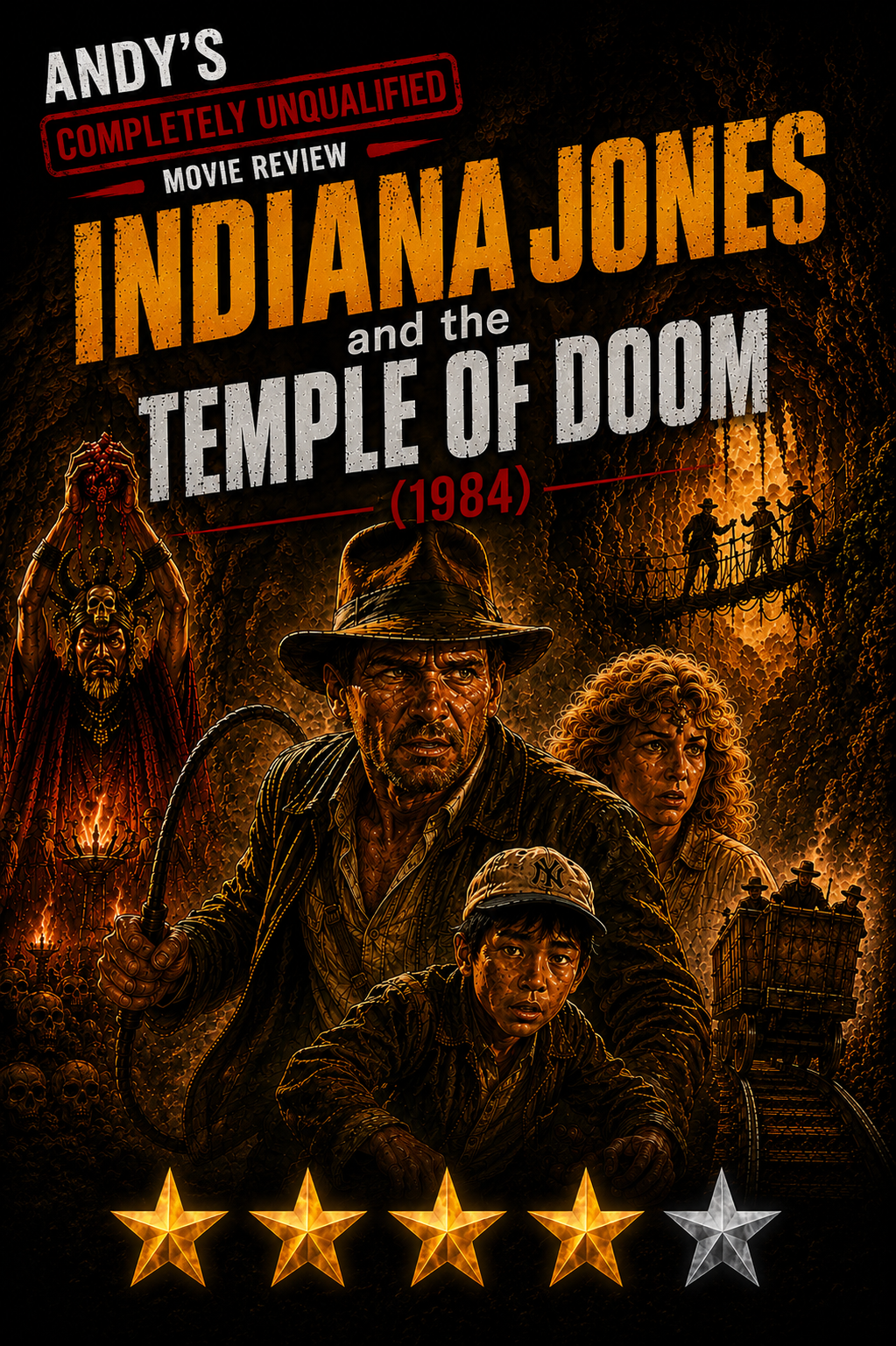
An archaeologist, a nightclub singer and an overenthusiastic child accidentally join a project that has no sponsor, no scope, no governance and absolutely no risk register.
What follows is a chaotic delivery programme involving poisoned drinks, missing children, improvised disaster recovery, questionable catering choices, a cult, a mine cart and one of the least advisable change management decisions in cinema history.
Somehow it still delivers.
Review
Temple of Doom is often remembered as the weird Indiana Jones film.
The dark one.
The strange one.
The one with the heart removal scene that probably traumatised an entire generation.
And whilst all of that is true, I think people miss the real lesson.
This is a project that starts without a business case.
Indiana Jones isn’t looking for anything.
He hasn’t been hired.
There are no requirements.
There is no sponsor.
There is no project plan.
There isn’t even a kick-off meeting.
In fact, the entire engagement begins because everybody is trying to steal something from everybody else in a Shanghai nightclub.
Which, now I think about it, is remarkably similar to some stakeholder workshops I’ve attended.
The opening sequence is brilliant.
Everyone is chasing something different.
The diamond.
The antidote.
The singer.
The money.
The escape route.
Nobody actually understands the wider objective.
They’re all focused on their own priorities.
Again, remarkably similar to some projects I’ve worked on.
Then we get the plane scene.
The pilots abandon the aircraft.
No parachutes.
No contingency plan.
No disaster recovery procedure.
No documented operating model.
No support contract.
Nothing.
So Indy does what every engineer eventually has to do.
He improvises.
The life raft becomes the solution.
Not because it was designed for the purpose.
Not because it was documented.
Not because it was approved by governance.
But because it was the only thing available.
Every experienced engineer has had one of those moments.
The solution wasn’t in the architecture.
The solution wasn’t in the documentation.
The solution was:
“I’ve got an idea. This is either going to work or we’re all getting fired.”
Somehow it works.
Then there’s Willie Scott.
The stakeholder.
Didn’t ask to be involved.
Didn’t want to be involved.
Complains constantly.
Questions every decision.
Demands updates.
Escalates frequently.
And somehow survives the entire project.
Every programme has one.
Then we have Short Round.
The world’s most energetic intern.
The apprentice.
The junior engineer.
The one constantly running around touching things they probably shouldn’t.
Breaking things.
Fixing things.
Saving the day.
And occasionally driving vehicles without appropriate authorisation.
Which sounds suspiciously like several graduate engineers I’ve met over the years.
In fact, Short Round is really the overenthusiastic junior engineer who somehow acquired permissions well beyond his job role.
Nobody remembers approving the access request.
Nobody knows how he got the permissions.
At this point everyone is too afraid to remove them because he’s fixing more problems than he’s creating.
Short Round might actually be the real hero of the film.
Nobody seems to notice because Indy gets all the credit.
Which is also surprisingly realistic.
The infamous banquet scene deserves special mention.
Snake surprise.
Chilled monkey brains.
Eyeball soup.
Most viewers react exactly the same way.
“What on earth is that?”
But that’s the point.
Different doesn’t automatically mean wrong.
It’s simply unfamiliar.
Technology is often the same.
Somebody shows a team a new tool.
Everyone hates it.
Everyone questions it.
Everyone assumes it’s ridiculous.
Three months later nobody remembers how they worked without it.
Then we arrive at Mola Ram.
The programme director.
The leader who has surrounded himself entirely with people who agree with him.
Nobody challenges assumptions.
Nobody questions decisions.
Nobody raises risks.
Everybody simply nods and says:
“Excellent idea.”
This turns out to be problematic.
Whether you’re running a cult or an enterprise transformation programme, the outcome is usually similar.
At some point reality arrives and asks difficult questions.
Then there’s the British Army.
As a British citizen now living in Scotland, I feel qualified to make this observation.
The incident is ultimately resolved when the customer decides to involve an organisation with considerably more resources than the original project team.
The Maharaja effectively escalates the issue.
The British Army respond.
And within minutes appear to have deployed enough resources to resolve a problem that had defeated everybody else for the previous two hours.
I suspect there was no ServiceNow incident raised.
No service ticket submitted.
No CAB approval.
No formal change request.
Yet somehow an entire military force appears in the middle of nowhere and closes the incident.
Love them or hate them, when the British decide to escalate a ticket, they rarely do things by halves.
The project team spend the entire film trying to solve the problem.
The British arrive with what can only be described as enterprise-scale incident response capability.
Then we reach the rope bridge.
Possibly the greatest risk decision in the entire Indiana Jones franchise.
There are no good options.
Only bad options and slightly less bad options.
So Indy does what many architects eventually do.
He makes a decision with no rollback plan and hopes for the best.
High risk.
High impact.
No safety net.
No change approval.
No rollback strategy.
Full send.
Fortunately for him, it works.
Again.
What makes Temple of Doom so enjoyable is that nobody really knows what they’re doing.
They’re making decisions in real time.
Improvising constantly.
Solving problems with whatever happens to be available.
And somehow, despite the complete lack of governance, structure or planning, they still manage to deliver for the customer.
Sometimes that’s all a successful project really is.
The Scorecard
Adventure: 5/5
Fun Factor: 5/5
Short Round’s Energy Levels: 100/5
Project Governance: 0/5
Risk Register: Missing
Business Case: Missing
Stakeholder Management: 2/5
Disaster Recovery Planning: Improvised
Catering: Questionable
Mine Cart Safety Standards: 0/5
ServiceNow Incident Management: Not Logged
Change Management: Not Approved
Privileged Access Controls: Short Round
Likelihood of Watching Again: 5/5
Likelihood of Recommending to Others: 5/5
Overall Score: 4/5
Final Verdict
Temple of Doom is what happens when a consultant accidentally accepts a project without scope, requirements, governance or a risk register and somehow still delivers for the customer.
It’s chaotic.
It’s ridiculous.
It’s occasionally terrifying.
And it’s incredibly entertaining.
Not the best Indiana Jones film.
But arguably the most fun.
Completely Unqualified Verdict
There was no project plan.
Indiana Jones was the project plan.
⭐⭐⭐⭐☆ 4.0 out of 5 stars
Poster Quote
There was no project plan.
Indiana Jones was the project plan.
Comments
Comments are not yet configured. Copy
.env.exampleto.env, fill in your Giscus values, and they will appear here.