Synopsis
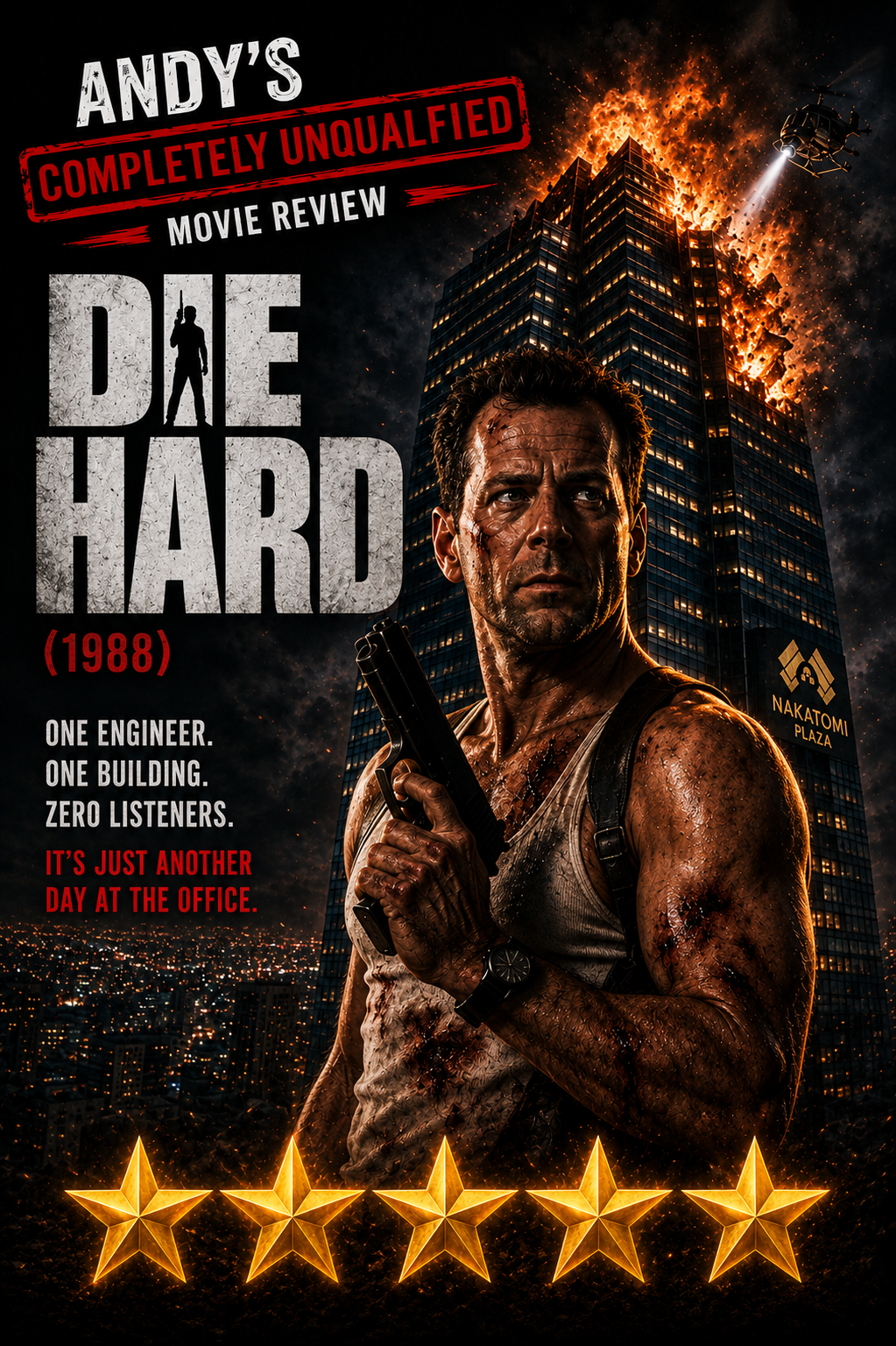
A New York police officer flies to Los Angeles to reconcile with his wife at a Christmas party.
Instead, he finds himself dealing with a hostile takeover, a failed business continuity plan, poor executive decision-making, questionable stakeholder engagement, a Big 4 consultancy engagement and one of the most expensive incident response failures in cinematic history.
In other words, a fairly standard corporate transformation programme.
Review
Let’s address the elephant in the room.
Yes.
It’s a Christmas movie.
There are Christmas songs.
Christmas decorations.
Christmas parties.
Christmas presents.
And a man running around a building delivering festive cheer to terrorists.
If Die Hard isn’t a Christmas movie, then neither is Home Alone.
Now that’s settled, let’s talk about Nakatomi Plaza.
Because Nakatomi Plaza isn’t really a building.
It’s a disaster recovery exercise waiting to happen.
Questions that should have been asked:
- What is our business continuity strategy?
- What is our disaster recovery plan?
- What is our response to a hostile takeover?
- Why are all senior executives in the same building?
- Why is Ellis allowed near decision making?
Apparently nobody thought this was important.
Then we meet John McClane.
McClane is the engineer.
Not management.
Not the architect.
Not the executive sponsor.
Not the programme director.
Just the person who understands how things actually work.
Which immediately makes him the most dangerous person in the building.
The reason Die Hard works so well is because McClane isn’t a superhero.
He’s tired.
He’s frustrated.
He’s underprepared.
He’s operating with incomplete information.
And he’s making it up as he goes.
Just like every engineer during a major incident.
Then there’s Hans Gruber.
Arguably one of the greatest villains ever put on screen.
Hans isn’t really a terrorist.
He’s a project manager.
Think about it.
Clear objectives.
Detailed planning.
Resource allocation.
Communications strategy.
Contingency plans.
Stakeholder management.
Risk mitigation.
Honestly, Hans Gruber has a better delivery plan than some transformation programmes I’ve seen.
The only problem is that his project objective is technically illegal.
Then we have Holly Gennaro.
The sponsor.
Trying desperately to keep everything together while everybody else makes increasingly poor decisions.
Every successful programme has one.
Most don’t get nearly enough credit.
Then we arrive at Ellis.
Every project has an Ellis.
The stakeholder who is absolutely convinced they are the smartest person in the room.
The stakeholder who believes they can personally solve the problem.
The stakeholder who volunteers for a task nobody asked them to perform.
The stakeholder who immediately makes everything worse.
If you’ve worked in technology long enough, you’ve met Ellis.
Possibly several times.
Then we have Sergeant Al Powell.
The remote support engineer.
The only person gathering useful information.
The only person listening.
The only person helping the person actually doing the work.
Which means he is immediately ignored by most of the people around him.
Naturally.
Then there’s Deputy Chief Dwayne T. Robinson.
The manager.
Not a bad person.
Not a villain.
Just completely convinced he understands the situation despite overwhelming evidence to the contrary.
Every incident eventually attracts one.
The manager who has already decided what the problem is before collecting any evidence.
The manager who ignores the engineer.
The manager who ignores the facts.
The manager who ignores reality.
McClane repeatedly tells him what’s happening.
McClane repeatedly tells him who the attackers are.
McClane repeatedly tells him what needs to be done.
Robinson repeatedly concludes that McClane is the problem.
Which is a surprisingly common management strategy.
If you’ve ever spent six months explaining a technical risk only to be told the real issue is your attitude, you’ve met Deputy Chief Robinson.
Then the FBI arrive.
Every major incident eventually attracts a Big 4 consultancy engagement.
The FBI arrive carrying frameworks.
Methodologies.
Operating models.
Target states.
Maturity assessments.
And enough PowerPoint slides to wallpaper Nakatomi Plaza.
The engagement is expensive.
The terminology is impressive.
The confidence is unwavering.
The understanding of the actual problem is considerably less impressive.
John McClane has spent the entire film gathering evidence.
Understanding the threat.
Assessing the risks.
Building a response plan.
The FBI arrive and immediately conclude that the person closest to the incident must obviously be wrong.
Because if there is one thing large consultancy engagements dislike, it’s local knowledge.
Several recommendations later, the situation is considerably worse than when they arrived.
The building is on fire.
Millions have been spent.
The incident has escalated.
And everybody eventually finds themselves back where they started.
Listening to the engineer.
The engineer who understood the problem from the beginning.
The engineer who proposed a solution from the beginning.
The engineer who was ignored from the beginning.
McClane was standing barefoot in the server room looking at the actual outage.
The FBI were reviewing the dashboard.
What makes Die Hard so special is that every decision has consequences.
Nobody has plot armour.
Nobody has magic powers.
Nobody is waiting for a superhero to save them.
The solution comes from persistence.
Experience.
Problem solving.
And one very determined engineer refusing to give up.
The Scorecard
Story: 5/5
Action: 5/5
Hans Gruber: 100/5
John McClane’s Problem Solving: 100/5
Al Powell’s Listening Skills: 100/5
Christmas Spirit: 5/5
Deputy Chief Robinson’s Situational Awareness: 0/5
Big 4 Consultancy Contribution: Decorative
Business Continuity Planning: 0/5
Disaster Recovery Planning: 0/5
Executive Decision Making: 0/5
Likelihood of Watching Again: 5/5
Likelihood of Recommending to Others: 5/5
Overall Score: 5/5
Final Verdict
Die Hard is what happens when an experienced engineer is dropped into a major incident and everyone else refuses to listen.
The executives panic.
The stakeholders interfere.
The consultants arrive.
The dashboards look impressive.
The situation gets worse.
And eventually everyone realises they should probably have listened to the person closest to the problem.
A lesson technology projects continue to relearn every single year.
Completely Unqualified Verdict
Nakatomi Plaza failed its business continuity test.
John McClane passed.
⭐⭐⭐⭐⭐ 5.0 out of 5 stars
Comments
Comments are not yet configured. Copy
.env.exampleto.env, fill in your Giscus values, and they will appear here.