Synopsis
A highly advanced programme leaves The Grid and enters the real world, bringing artificial intelligence, digital lifeforms and existential threats to humanity.
Or, to put it another way:
Someone approved a proof-of-concept for production deployment without completing the risk assessment.
What could possibly go wrong?
What I Expected
As somebody who genuinely enjoyed Tron: Legacy, I was looking forward to this.
Not because I expected perfection.
Not because I expected another masterpiece.
I simply wanted to return to The Grid.
I wanted the atmosphere.
I wanted the visual style.
I wanted the sense of wonder that made Tron: Legacy memorable.
And, if I am being completely honest, I wanted Daft Punk.
What I Got
What I got felt remarkably familiar.
Not as a film.
As an enterprise transformation programme.
Specifically, the kind that starts with a successful platform, a recognised brand and a loyal customer base before somebody decides to modernise everything.
You know the type.
The original architects leave.
The leadership team changes.
A new strategy is introduced.
The roadmap gets rewritten.
Somebody starts talking about synergies.
And before long nobody can quite remember why customers liked the original product in the first place.
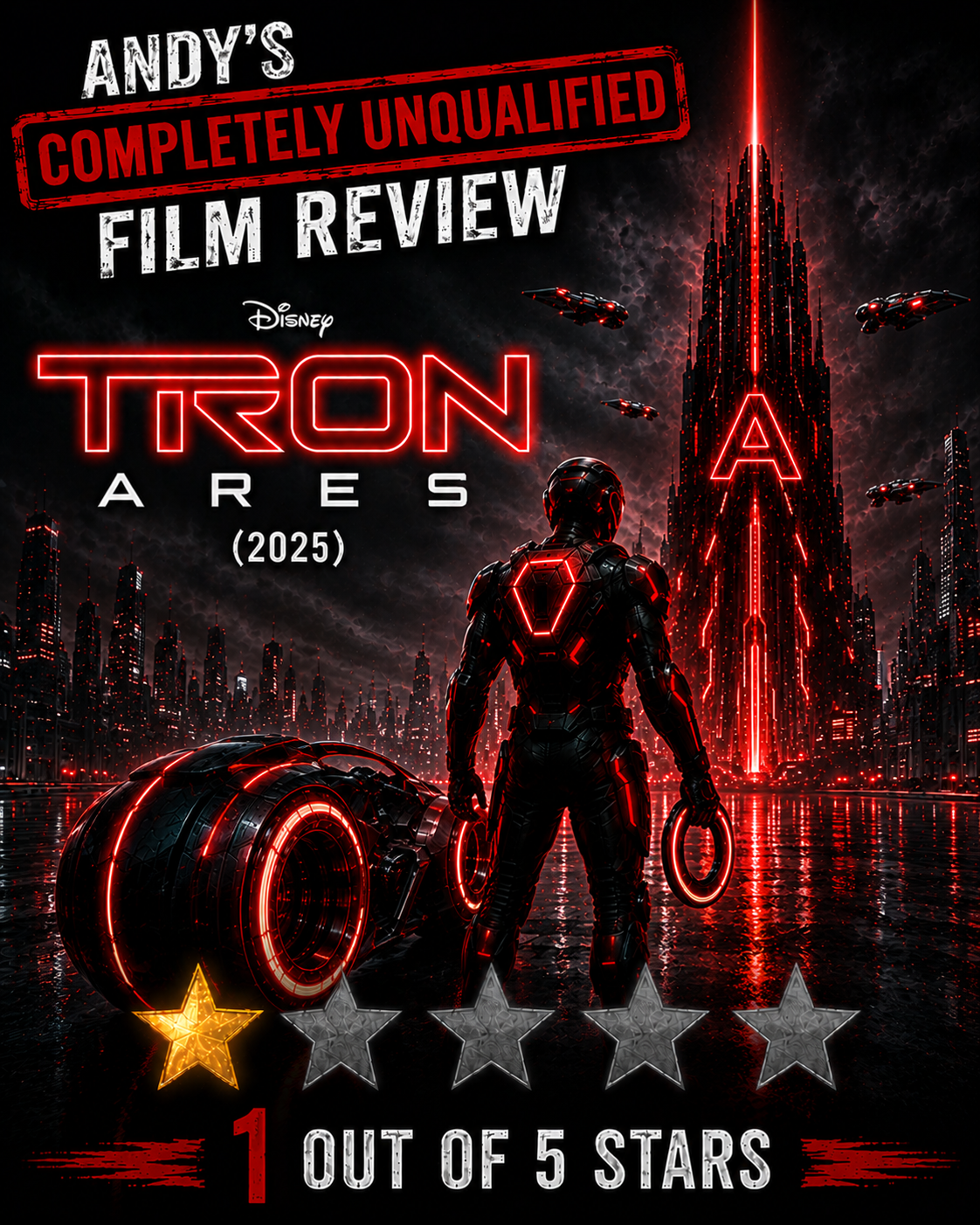
That is Tron: Ares.
The visuals are impressive.
In places they are genuinely spectacular.
The technology looks fantastic.
The effects are polished.
The production budget is clearly visible on screen.
But looking like Tron and feeling like Tron are two very different things.
Review
The biggest problem with Tron: Ares is not that it is terrible.
The biggest problem is that it is forgettable.
I have seen it twice.
And despite two viewings, I struggle to remember much about it.
That is not a great sign.
Particularly when I can still remember scenes, music and moments from Tron: Legacy years after first watching it.
The acting is perfectly adequate.
The story exists.
The characters do things.
Events occur.
Yet somehow very little of it leaves any lasting impression.
It is the cinematic equivalent of sitting through a three-hour strategy workshop and leaving with forty PowerPoint slides but no clear decisions.
Then we arrive at the largest governance failure in the entire production.
Daft Punk.
Or more accurately:
The complete absence of Daft Punk.
The soundtrack in Tron: Legacy was not simply background music.
It was part of the identity of the film.
It elevated every scene.
It gave The Grid personality.
It transformed ordinary moments into memorable moments.
Tron: Ares has music.
Tron: Legacy had Daft Punk.
Those are not the same thing.
Then there is Jared Leto.
Now, I am sure Jared Leto is a perfectly decent human being.
I have never met him.
I have nothing against him personally.
In fact, I have reached the conclusion that Jared Leto is not necessarily the problem.
He simply appears to possess a remarkable ability to attach himself to projects that were already heading towards trouble.
Some actors collect awards.
Jared Leto appears to collect post-mortem reviews.
It is a unique talent.
At this point I am not convinced he is causing these films to struggle.
I think he is simply arriving just in time to witness the inevitable.
Security Assessment
As a Security and Identity Architect, I feel obligated to point out that The Grid continues to demonstrate a concerning lack of security maturity.
Despite possessing advanced artificial intelligence, autonomous digital lifeforms and technology capable of crossing between worlds, I observed no evidence of:
- Phishing-resistant MFA
- Conditional Access
- Session Controls
- Privileged Identity Management
- Risk-Based Authentication
- Authentication Context
Highly privileged identities appear to operate continuously without challenge.
Administrative actions occur without approval.
Access decisions seem to be based largely on plot convenience.
And nobody appears remotely concerned about privilege escalation.
Had The Grid implemented modern identity controls, the majority of the events in this film would likely have failed during user acceptance testing.
Enterprise Architecture Assessment
This film feels remarkably similar to many failed transformation programmes I have seen over the years.
A successful platform was acquired.
The original vision faded.
Key contributors disappeared.
Leadership changed.
The roadmap drifted.
The result technically works.
The branding remains recognisable.
The architecture survived.
But the thing people actually cared about never successfully migrated.
I have seen organisations spend millions modernising systems only to discover they accidentally removed everything users liked about them.
That is Tron: Ares.
Final Verdict
Tron: Ares is not the worst film I have ever watched.
That would require it to leave a stronger impression.
Instead, it is something arguably worse.
Forgettable.
It looks good.
It sounds fine.
It functions.
But it never justifies its existence.
Tron: Legacy was not perfect.
But it had identity.
It had atmosphere.
It had soul.
Tron: Ares feels like a rebranding exercise that somehow lost the original business case halfway through delivery.
Completely Unqualified Verdict
Conditional Access Assessment
Request: Release Tron: Ares to Production
Business Justification: People liked Tron: Legacy
Compensating Controls: None Identified
Daft Punk Dependency: Missing
Risk Level: Critical
User Demand: Not Evidenced
Decision: BLOCK
Reason: Insufficient evidence that users requested this change.
Scorecard
Story: 1/5
Acting: 2/5
Visuals: 4/5
Soundtrack: 1/5
Security Controls: 0/5
Governance: 1/5
Would Recommend: 1/5
Overall: 1/5
Would I watch again? Maybe.
Comments
Comments are not yet configured. Copy
.env.exampleto.env, fill in your Giscus values, and they will appear here.