Executive Summary
Following the successful destruction of the Death Star, the Rebel Alliance enters a period of cautious optimism.
The project appears complete.
The primary objective has been achieved.
Stakeholders are celebrating.
Lessons learned have not yet been documented.
Unfortunately, the underlying problem remains unresolved.
The Empire still exists.
Funding remains available.
Executive sponsorship remains firmly in place.
And Darth Vader has entered what can only be described as an aggressive programme recovery phase.
The result is one of the greatest sequels ever made and a textbook example of unmanaged risk, uncontrolled scope creep, changing contractual terms and the consequences of ignoring a well-maintained RAID log.
Programme Governance
The Rebel Alliance continues to operate with remarkably little formal governance.
Key strategic decisions appear to be made by whichever individual happens to be standing closest to the Millennium Falcon at the time.
No steering committee is observed.
No architecture board exists.
No change approval process is evident.
This becomes particularly relevant later.
Disaster Recovery & Business Continuity
The opening events on Hoth provide a surprisingly mature example of disaster recovery planning.
When the base is compromised:
- Leadership is preserved
- Critical personnel are evacuated
- Essential assets are extracted
- Alternative operating locations exist
The site itself is lost, but organisational continuity is maintained.
This is perhaps the most successful disaster recovery exercise in the entire Star Wars saga.
Stakeholder Management
Darth Vader’s leadership style continues to raise concerns.
Progress updates that fail to meet expectations frequently result in immediate personnel changes.
Unfortunately, these changes often involve force-choking senior staff.
Whilst effective in the short term, this approach presents significant challenges for employee engagement, succession planning and long-term retention.
Annual staff surveys are unlikely to be favourable.
Scope Creep
The original objective appears straightforward: Capture the Millennium Falcon.
However, requirements quickly expand:
- Capture Luke Skywalker
- Capture Rebel leadership
- Recruit Luke to the organisation
- Restructure Cloud City operations
- Engage third-party bounty hunters
- Facilitate family reconciliation
At no stage is a revised Statement of Work produced.
No change requests are raised.
No impact assessments are completed.
Scope expands continuously throughout delivery.
Pilot Deployment & Proof of Concept
One area where Darth Vader demonstrates surprisingly strong programme discipline is solution validation.
Having identified a requirement to capture Luke Skywalker alive, Vader intends to use carbon freezing as part of the implementation.
However, rather than immediately deploying the process against the primary stakeholder, he conducts a pilot first.
Han Solo is selected as the proof of concept.
Whilst concerns are raised regarding operational viability, Vader proceeds with controlled testing before wider rollout.
The pilot is deemed successful.
Key findings include:
- Subject survives implementation
- Process achieves desired outcome
- Recovery appears possible
- Stakeholder dissatisfaction remains high
Only after successful validation does Vader approve the solution for production use.
This represents one of the few examples of structured project delivery observed throughout the film.
Unlike Luke, Vader appears to have reviewed the risk register.
| Area | Outcome |
|---|---|
| Pilot Executed | ✅ |
| Test Subject Available | ✅ |
| Success Criteria Defined | ✅ |
| Technical Validation Completed | ✅ |
| Production Rollout Approved | ✅ |
| Ethics Review Performed | ❌ |
| Stakeholder Consent Obtained | ❌ |
| Change Advisory Board Approval | ❌ |
From a programme delivery perspective, this is arguably the most mature piece of project management displayed by any character in the film.
The fact that the pilot subject was a smuggler frozen against his will is largely outside the scope of this assessment.
Vendor & Contract Management
Cloud City provides a valuable lesson in supplier governance.
Lando Calrissian enters negotiations with the Empire without legal review, procurement oversight or a signed Statement of Work.
The consequences are immediate.
Contractual terms are modified repeatedly.
Previously agreed conditions are withdrawn.
Additional requirements are introduced without consultation.
As Lando accurately observes:
“This deal is getting worse all the time.”
Every project manager watching immediately develops mild anxiety.
Documentation & Knowledge Management
After sustaining significant damage, C-3PO is disassembled and later reassembled by Chewbacca.
Whilst operational, the resulting implementation exhibits several defects.
This strongly suggests:
- Missing technical documentation
- Incomplete support procedures
- Poor configuration management
- No available knowledge base
- No handover documentation
The rebuild appears to have been performed entirely from memory.
As anyone who has inherited undocumented infrastructure knows, this rarely ends well.
RAID Review
Yoda and Obi-Wan conduct what is arguably the most comprehensive risk assessment in the original trilogy.
The risks are identified.
The risks are documented.
The risks are communicated.
The risks are acknowledged.
The stakeholder proceeds anyway.
| ID | Type | Description | Status |
|---|---|---|---|
| R001 | Risk | Jedi training incomplete | Open |
| R002 | Risk | Vader significantly stronger than anticipated | Open |
| R003 | Risk | Emotional decision making likely | Open |
| I001 | Issue | Han and Leia captured | Active |
| A001 | Assumption | Luke is ready to face Vader | Incorrect |
| D001 | Dependency | Complete Jedi training before engagement | Ignored |
| R004 | Risk | Severe personal injury | Materialised |
| R005 | Risk | Discovery of sensitive family information | Materialised |
| I002 | Issue | Vader is Luke’s father | Active |
Had this RAID log existed within Azure DevOps, it is reasonable to assume Luke would have reviewed the risks, accepted the risks, ignored the mitigations, closed the sprint, and deployed to production anyway.
Risk Realisation
Unlike many projects where risks are simply recorded and forgotten, The Empire Strikes Back takes a refreshingly realistic approach.
Every significant risk materialises.
Luke ignores training dependencies.
He confronts a superior adversary.
He suffers severe personal injury.
He fails to achieve his objective.
And discovers that the individual responsible for removing his hand is also his father.
This represents a significant undocumented parental dependency discovered very late in the programme lifecycle.
Stakeholder impact was considerable.
Talent Acquisition
The Empire Strikes Back introduces Boba Fett.
Unlike most Imperial personnel, Boba demonstrates initiative, competence and independent problem solving.
Despite limited screen time, he quickly establishes himself as one of the most effective resources available.
The fact that he achieves this while saying very little raises uncomfortable questions regarding the Empire’s wider recruitment strategy.
Architecture & Programme Assessment
| Area | Rating | Comments |
|---|---|---|
| Governance | ⭐⭐☆☆☆ | Strategic decisions largely made without oversight |
| Change Control | ⭐☆☆☆☆ | Scope changes continuously throughout delivery |
| Risk Management | ⭐☆☆☆☆ | Risks identified correctly and then ignored |
| RAID Discipline | ⭐☆☆☆☆ | Excellent RAID log. No evidence of compliance |
| Disaster Recovery | ⭐⭐⭐⭐⭐ | Hoth evacuation executed successfully |
| Documentation | ⭐☆☆☆☆ | C-3PO rebuilt without any apparent documentation |
| Vendor Management | ⭐☆☆☆☆ | Cloud City accepted changing contract terms repeatedly |
| Stakeholder Management | ⭐⭐☆☆☆ | Vader’s approach remains problematic |
| Talent Acquisition | ⭐⭐⭐⭐⭐ | Successful onboarding of Boba Fett |
| Security Controls | ⭐⭐☆☆☆ | Tracking and surveillance capabilities remain concerning |
| Programme Delivery | ⭐⭐⭐⭐☆ | Objectives achieved, although not necessarily by the intended party |
| Lessons Learned | ⭐⭐⭐⭐⭐ | Stakeholders unlikely to repeat these mistakes |
Overall Maturity Assessment: Critical
Significant weaknesses exist across governance, risk management, change control and supplier engagement.
However, strong disaster recovery capabilities, effective resource acquisition and exceptional execution prevent complete programme failure.
Movie Hub Metrics
| Metric | Result |
|---|---|
| Risks Ignored | 5 |
| Issues Escalated | 2 |
| Assumptions Proven Wrong | 1 |
| Critical Dependencies Ignored | 1 |
| Statements of Work Signed | 0 |
| Change Requests Approved | 0 |
| Contract Variations | Too many |
| Limbs Lost | 1 |
| Family Surprises | 1 |
| Bounty Hunters Introduced | 1 |
| Death Stars Destroyed | 0 |
| Overall Outcome | Complicated |
Final Assessment
The Empire Strikes Back succeeds because the heroes fail.
The risks materialise.
The issues escalate.
The assumptions prove incorrect.
The dependencies are ignored.
The stakeholder suffers catastrophic consequences.
And yet the story remains compelling because actions have consequences.
Much like real technology programmes.
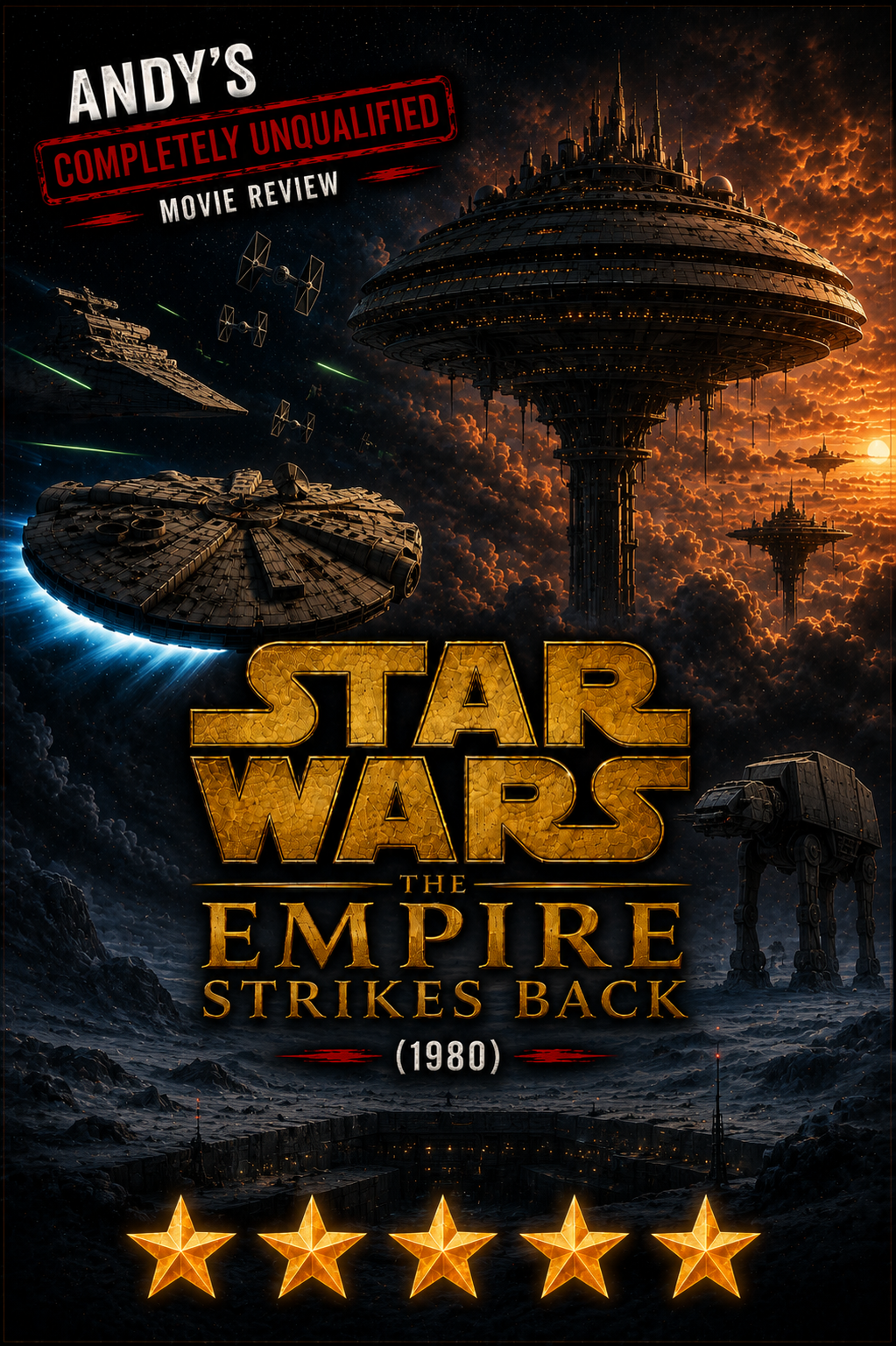
Completely Unqualified Verdict: One of the greatest films ever made. An equally impressive example of what happens when nobody follows the RAID log.
Comments
Comments are not yet configured. Copy
.env.exampleto.env, fill in your Giscus values, and they will appear here.