Executive Summary
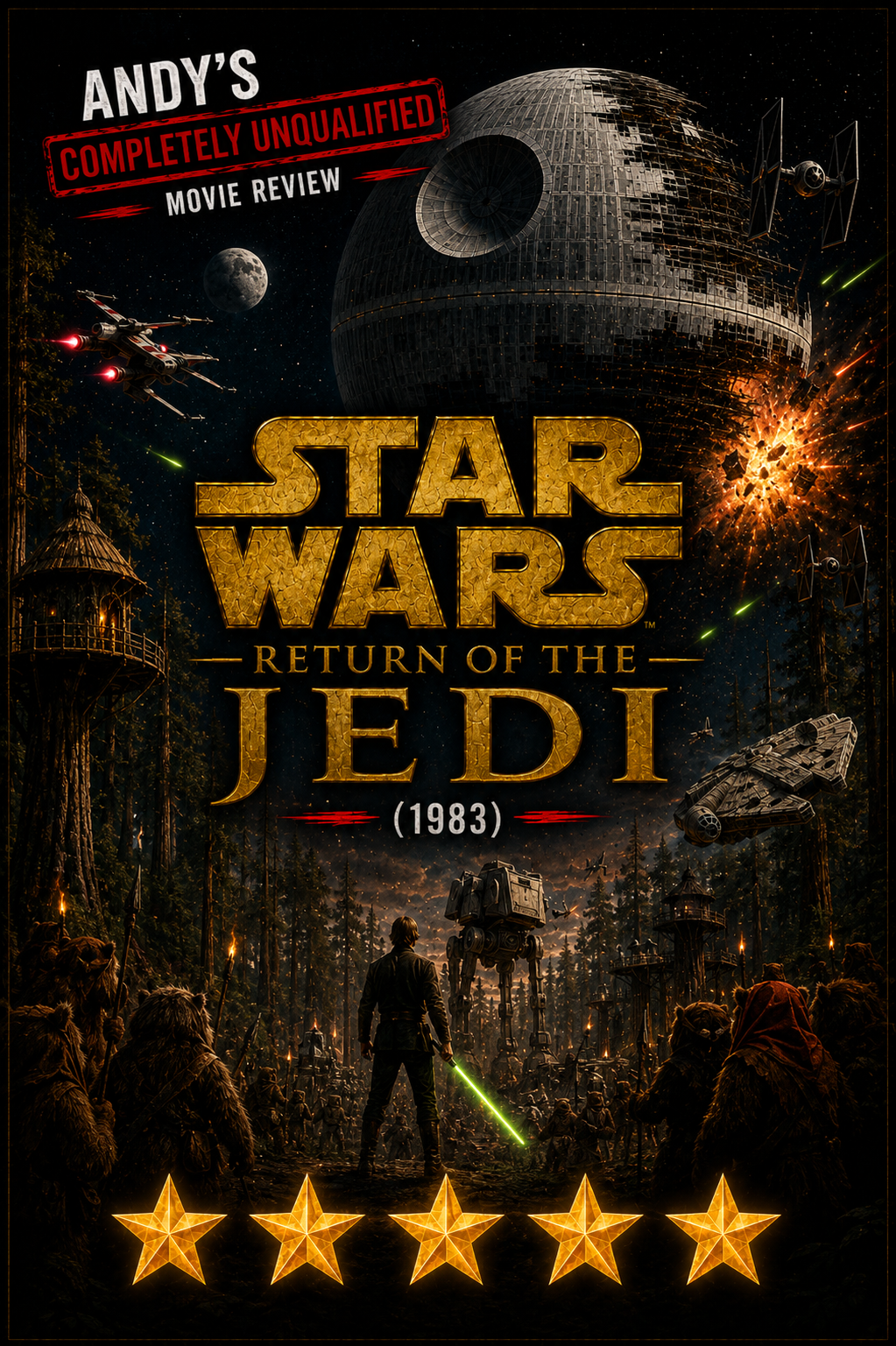
Return of the Jedi concludes the original Star Wars trilogy with a film that somehow manages to be simultaneously epic, emotional, ridiculous and deeply satisfying.
The Empire has spent years building a second Death Star.
The Rebels are planning a high-risk assault.
The Emperor has developed what he believes to be the perfect trap.
Luke Skywalker insists he is now a Jedi.
And somewhere on a forest moon, a group of technologically primitive teddy bears are preparing to become one of the most effective resistance movements in galactic history.
As a film, Return of the Jedi is a fantastic conclusion to the trilogy.
As a governance review, it raises significant concerns.
Movie Scorecard
| Category | Rating | Comments |
|---|---|---|
| Story | ⭐⭐⭐⭐⭐ | Delivers a satisfying conclusion to the trilogy |
| Characters | ⭐⭐⭐⭐⭐ | Strong arcs for Luke, Vader, Han and Leia |
| Villains | ⭐⭐⭐⭐⭐ | The Emperor remains one of cinema’s great villains |
| Action | ⭐⭐⭐⭐⭐ | The Battle of Endor is outstanding |
| Visual Effects | ⭐⭐⭐⭐⭐ | Still impressive more than forty years later |
| World Building | ⭐⭐⭐⭐⭐ | Expands the galaxy without losing focus |
| Emotional Impact | ⭐⭐⭐⭐⭐ | Redemption, sacrifice and closure all land perfectly |
| Rewatchability | ⭐⭐⭐⭐⭐ | One of the easiest films to revisit |
| Ewoks | ⭐⭐⭐⭐☆ | Divisive for some. Not for me |
| Ending | ⭐⭐⭐⭐⭐ | A near-perfect conclusion to the original trilogy |
Overall Movie Assessment: Exceptional — An epic and emotional finale that delivers action, character development and one of cinema’s most memorable endings.
Identity Governance & Role Assignment
One question remains largely unanswered throughout the film.
Luke Skywalker repeatedly introduces himself as:
“I am a Jedi.”
This immediately raises governance concerns.
Who approved this role assignment?
Was a formal assessment completed?
Was competency validated?
Did anyone sign off the request?
Yoda is on long-term sick leave.
Obi-Wan appears only in a consultancy capacity.
The Jedi Council no longer exists.
Luke appears to have granted himself the role.
This represents the galaxy’s first documented case of Self-Service Privileged Role Elevation.
Whilst technically successful, the approval process remains questionable.
Project Delivery & Unrealistic Deadlines
Construction of the second Death Star is significantly behind schedule.
When Vader visits the project site, General Jerjerrod explains the obvious: the Emperor’s deadline is unrealistic.
The response from leadership is equally familiar:
“Work harder.”
No additional resources.
No scope reduction.
No timeline revision.
Simply increased pressure.
The assumption that fear can overcome the laws of physics remains a common management mistake.
As every project manager knows: nine women cannot produce a baby in one month.
Neither can intimidation accelerate the construction of a moon-sized battle station.
Security Architecture
On paper, Imperial security appears impressive.
The solution includes:
- A moon-sized battle station
- A planetary shield generator
- An Imperial fleet
- Ground forces
- Surveillance capabilities
- Multiple defensive layers
The architecture is technically sound.
The assumptions behind it are not.
The Empire becomes so focused on expected threats that it largely ignores unexpected ones.
This proves costly.
Access Reviews & Legacy Authentication
The Rebel strike team gains access to Endor using old Imperial clearance codes.
This should not have happened.
Questions immediately arise:
- Why are these credentials still active?
- When was the last access review?
- Was there no credential rotation policy?
- Were stale permissions removed?
- Did nobody review privileged access assignments?
The Empire appears to have invested heavily in technology while neglecting basic identity governance.
Many organisations continue to make the same mistake today.
Threat Modelling
The Empire conducts extensive planning around the Rebel assault.
The threat model successfully accounts for:
- Starfighters
- Capital ships
- Ground assaults
- Special operations teams
It does not account for:
- Primitive woodland inhabitants
- Log-based attack vectors
- Rope-assisted mobility solutions
- Coordinated bear attacks
This omission ultimately proves significant.
Threat modelling should include realistic adversary behaviour.
The definition of “realistic” remains open for discussion.
Shadow IT
The Ewoks represent perhaps the most successful Shadow IT deployment in cinematic history.
They are:
- Unapproved
- Unmanaged
- Unsupported
- Entirely outside governance
Yet they consistently outperform the approved solution.
This is both deeply frustrating and surprisingly realistic.
Honeypots & Controlled Exposure
The Emperor intentionally allows the Rebels to discover the second Death Star.
The station appears vulnerable.
Intelligence is leaked.
The trap is carefully prepared.
This is effectively a large-scale honeypot operation.
The strategy itself is sound.
The problem is overconfidence.
The Emperor becomes so convinced of success that he stops considering alternative outcomes.
This is a useful reminder that successful security controls still require continuous validation.
A trap is only effective until somebody behaves unexpectedly.
Troubleshooting Under Pressure
During the battle over the Great Pit of Carkoon, Han Solo temporarily loses his sight.
Faced with uncertainty and limited information, he proceeds to fire his weapon in approximately the correct direction and hopes for the best.
Many network engineers will find this troubleshooting methodology uncomfortably familiar.
Whilst not recommended, it occasionally works.
Leadership & Stakeholder Management
The Emperor leads through confidence.
Vader leads through fear.
Neither approach proves particularly sustainable.
Throughout the film, Imperial leadership becomes increasingly convinced of its own success.
The Rebels spend most of their time improvising.
Ironically, the organisation with the least confidence in its plan demonstrates the greatest adaptability.
Architecture & Programme Assessment
| Area | Rating | Comments |
|---|---|---|
| Identity Governance | ⭐☆☆☆☆ | Luke self-approved Jedi access |
| Access Reviews | ⭐☆☆☆☆ | Legacy credentials remained active |
| Legacy Authentication | ⭐☆☆☆☆ | Credential rotation appears absent |
| Security Architecture | ⭐⭐⭐☆☆ | Strong controls built on weak assumptions |
| Threat Modelling | ⭐☆☆☆☆ | Nobody considered Ewoks |
| Shadow IT Management | ⭐☆☆☆☆ | Entirely unmanaged woodland resources |
| Project Management | ⭐☆☆☆☆ | Schedule driven by fear rather than reality |
| Change Control | ⭐⭐☆☆☆ | Objectives changed frequently |
| Executive Leadership | ⭐☆☆☆☆ | Excessive confidence throughout |
| Business Continuity | ⭐⭐⭐⭐☆ | Rebel resilience remains impressive |
| Operational Adaptability | ⭐⭐⭐⭐⭐ | Rebels adapt when plans fail |
| Lessons Learned | ⭐⭐⭐⭐⭐ | Empire unlikely to repeat these mistakes |
Overall Maturity Assessment: Critical — Significant weaknesses exist across identity governance, access reviews, threat modelling and programme delivery. The technology is impressive. The governance is not.
Movie Hub Metrics
| Metric | Result |
|---|---|
| Jedi Role Requests Approved | 0 |
| Self-Service Role Elevations | 1 |
| Legacy Credentials Still Active | 1 (Critical) |
| Access Reviews Performed | 0 |
| Threat Models Missing Ewoks | 1 |
| Shadow IT Deployments | 1 |
| Unrealistic Deadlines | 1 (Moon-Sized Project) |
| Assumptions Proven Incorrect | Many |
| Forest Creatures Underestimated | Severely |
| Death Stars Destroyed | 1 |
| Emperors Retained | 0 |
| Bear Attacks Encountered | More Than Expected |
Final Assessment
Return of the Jedi is a reminder that technology alone does not guarantee success.
The Empire possesses superior infrastructure.
Superior resources.
Superior security controls.
Superior funding.
Yet it loses because it places too much faith in assumptions and too little attention on governance, adaptability and basic access management.
The Rebels win not because their plan is perfect.
They win because they adapt when the plan inevitably falls apart.
Much like successful technology programmes.
Completely Unqualified Verdict: A fitting conclusion to one of cinema’s greatest trilogies. And a useful reminder that even the most sophisticated security architecture can still be defeated by legacy credentials, Shadow IT and an unexpected bear attack.
Comments
Comments are not yet configured. Copy
.env.exampleto.env, fill in your Giscus values, and they will appear here.