
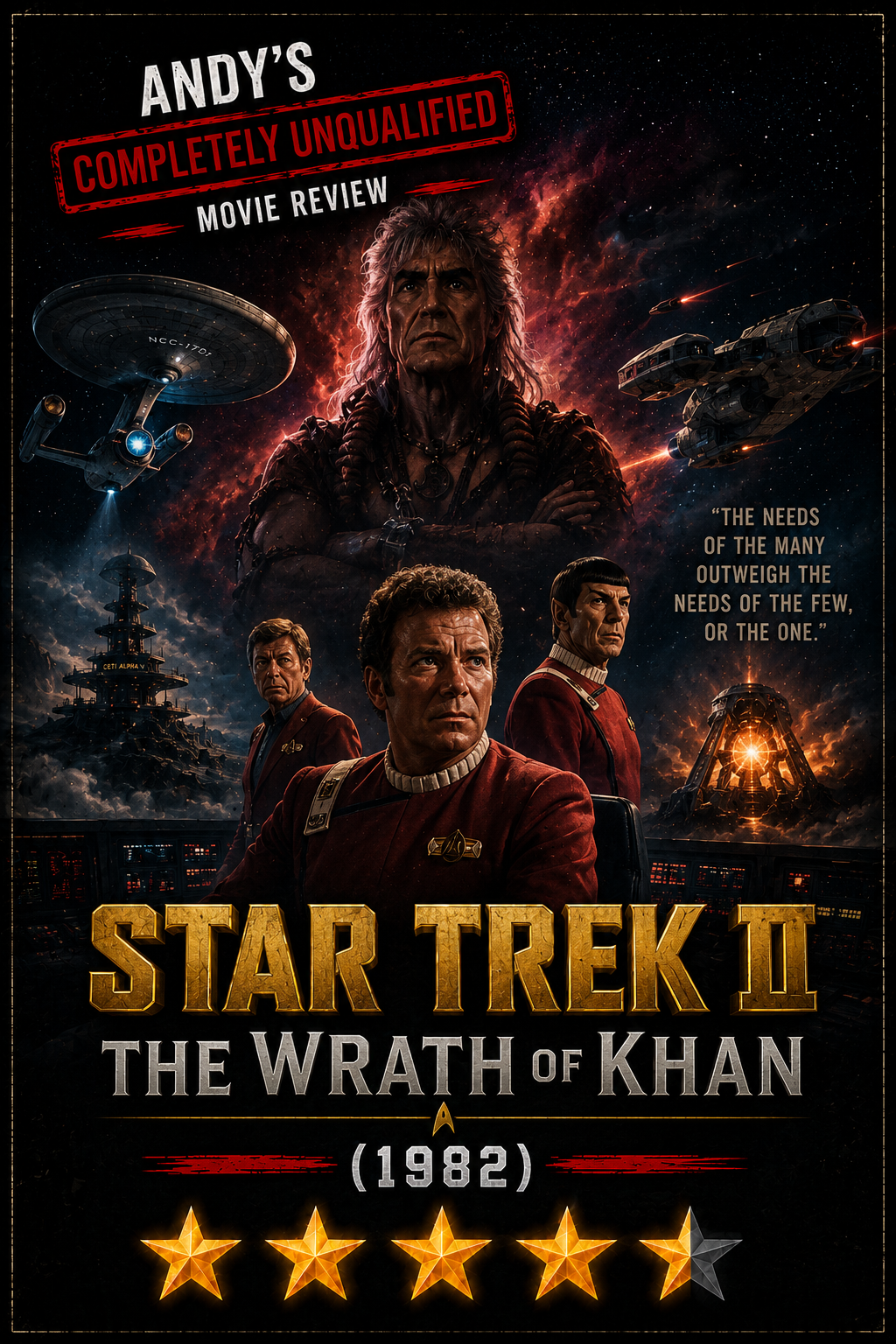
Andy’s Completely Unqualified Movie Review
Star Trek II: The Wrath of Khan (1982)
⭐⭐⭐⭐½
Synopsis
Admiral James T. Kirk is having what can only be described as a mid-life crisis in space.
He’s older.
He’s questioning his purpose.
He’s spending more time behind a desk than in the captain’s chair.
And then a genetically enhanced superhuman with a grudge the size of a galaxy decides it’s finally time for revenge.
What follows is not only one of the best Star Trek films ever made, but one of the best science fiction films ever made.
Full stop.
What I Expected
I’ll be honest.
As someone who grew up with The Next Generation, Deep Space Nine and Voyager, the original crew always felt a little dated.
The uniforms looked old.
The effects looked old.
And the pacing often felt slower than modern sci-fi.
So I expected a good Star Trek film.
What I didn’t expect was a masterclass in storytelling.
What I Got
The Wrath of Khan succeeds because it isn’t really about spaceships.
It’s about consequences.
Every major event in the film is the result of decisions made years earlier.
Kirk’s past decisions return to haunt him.
Khan’s obsession consumes him.
The Genesis Project demonstrates that technological breakthroughs often come with unintended consequences.
And throughout it all the film explores ageing, responsibility, sacrifice and legacy.
This isn’t a story about defeating a villain.
It’s a story about dealing with the consequences of your own history.
Which is probably why it still holds up more than forty years later.
Khan
Let’s talk about Khan.
Because Khan Noonien Singh is one of the greatest villains in science fiction.
Not because he’s evil.
Not because he’s powerful.
Because he’s understandable.
His motivations are clear.
His anger makes sense.
His obsession is believable.
He isn’t trying to conquer the galaxy.
He wants revenge.
Pure, focused, all-consuming revenge.
And Ricardo Montalban absolutely owns every scene he’s in.
The performance is theatrical, dramatic and completely unforgettable.
You never doubt for a second that Khan would burn down an entire star system if it meant getting one step closer to Kirk.
The Battle
The space combat deserves special mention.
Modern science fiction often relies on endless visual effects and huge fleets.
Wrath of Khan takes a different approach.
Most of the battle feels closer to submarine warfare than traditional space combat.
Limited visibility.
Cat-and-mouse tactics.
Careful positioning.
Predicting your opponent’s next move.
The result is tense, intelligent and surprisingly exciting.
Especially considering it was made in 1982.
The Cyber Security Corner
Because apparently I can’t watch a film anymore without thinking about security.
The entire plot is basically a collection of governance failures.
Forgotten Assets
Khan and his followers are abandoned and effectively forgotten.
No review.
No monitoring.
No validation.
No follow-up.
Twenty years later it becomes everyone’s problem.
That’s not a villain.
That’s an asset inventory failure.
Identity Lifecycle Management
Kirk is able to remotely disable the Reliant using command codes that should almost certainly have been rotated years ago.
Standing privilege.
Legacy trust.
Poor lifecycle management.
Sound familiar?
Genesis
The Genesis Project is the perfect example of a pilot that looked fantastic in a demonstration.
Everyone gets excited.
Funding gets approved.
Success is declared.
And then later we discover the testing wasn’t nearly thorough enough.
Every architect reading this has probably lived through a Genesis Project at some point.
Kirk
Let’s be honest.
If James T. Kirk worked in your organisation he would be a nightmare.
He ignores procedures.
He bypasses controls.
He takes risks.
He wins through sheer determination and charisma.
Fortunately for Starfleet, he’s usually right.
Unfortunately for security teams, that’s exactly how exceptions become incidents.
The Moment
Every great film has one scene.
The scene.
The one everyone remembers.
For Wrath of Khan, it’s the engine room.
No spoilers for the handful of people who somehow haven’t seen it yet.
But few films have delivered a sacrifice with as much emotional impact, dignity and meaning as this one.
Even now, decades later, it still lands.
Final Verdict
The Wrath of Khan is everything great science fiction should be.
It has action.
It has tension.
It has memorable characters.
It has one of cinema’s greatest villains.
But more importantly, it has something to say.
About ageing.
About responsibility.
About friendship.
About consequences.
And about the fact that some decisions never really go away.
It remains the benchmark for Star Trek films and one of the finest science fiction movies ever made.
Not bad for a film that is older than many of the people reading this review.
Rating
⭐⭐⭐⭐½
Comments
Comments are not yet configured. Copy
.env.exampleto.env, fill in your Giscus values, and they will appear here.